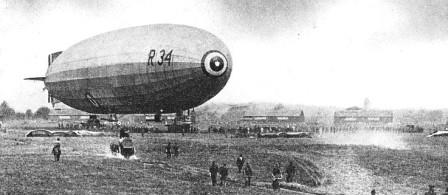
During the summer of 1919 the R34 crossed and recrossed the North Atlantic to establish a record which was only beaten by the “Graf Zeppelin” in 1928 and the R100 in 1930
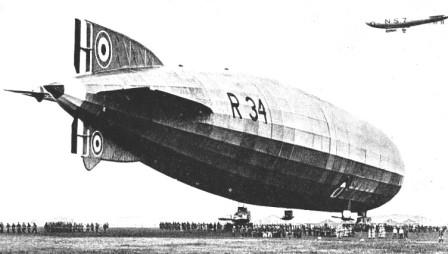
FROM THE OLD WORLD TO THE NEW IN RECORD TIME. A rigid dirigible, based on the model of the German Zeppelin L33, the R34 is seen at East Fortune, on the Scottish coast, whence she started on her transatlantic flight on July 2, 1919. The gondolas and the control car can be plainly seen, and the contrast in size with the non-rigid dirigible is remarkable.
IN the world of flight the aeroplane holds pride of place, moving from one achievement to another, forging ahead with unceasing progress. Yet the airship too, has contributed in no small degree to the conquest of the air, although it is shunned and regarded with disfavour in many countries. Its record, it is true, is marred with failure and disaster, but it has also had its triumphs. And one of the most remarkable of these was the flight from Britain to America and back of the R34 in July, 1919, when she flew to New York in 108 hours (July 2-6) and returned in 75 hours (July 10-13).
At that time the world had already heard with wonderment of the first direct crossing of the Atlantic from the American side by Alcock and Brown in their aeroplane (see the chapter under “The Conquest of the North Atlantic”), and interest ran high when it was learned a few weeks afterwards that a British airship was scheduled to fly from Scotland to America in the early part of July. Though it was less of a sporting venture than the flights of Hawker, who had failed, and of Alcock, who had succeeded, the idea of that great flying ship with 30 gallant men aboard, cruising above the ocean to link the two continents, was one that caught popular fancy. The expedition was essentially “official”; it was organized by the Air Ministry, the airship being a service craft manned by a service crew. It was 643 ft. in length, and was powered with five Sunbeam engines of 275 h.p. each. She was the most advanced type so far built in England, and her crew were under the command of Major George Herbert Scott.
Carefully and efficiently preparations had been made, and at 1.23 a.m. on July 2 the airship was brought from her shed at East Fortune, East Scotland, by a ground party. Orders rang out, a bugle sounded “All Clear”, and within a few moments the R34 had risen to the low-flying clouds and disappeared in the darkness. It was a night of boisterous wind and rain — conditions that were hardly encouraging for such an ambitious project as a double crossing of the North Atlantic. But with traditional service efficiency the R34 started “according to plan”, and, with her powerful engines opened up, she sped towards the Firth of Forth on the first stage of her long journey across the western ocean.
As she nosed through the night, her commander climbed her to 1,500 feet, and through the windows of the control car Major Scott and his helmsmen, Sergeant-Major Walter Mayes and Sergeant H. M. Watson, could see all around them the lights of towns, appearing as myriads of gleaming pin-points far below. There is much to do on a big dirigible, and each member of the first watch busied himself with his respective job as the R34 flew onward, her engines blending to make a heavy sonorous song.
Aided by a following wind, good progress was maintained, and by 4.30 a.m. the northern coast of Ireland was seen, mist-clad and ghostly in the pale light of the coming day. Those first hours over the Atlantic must have been thrilling for the men of the R34, for then, when the last vestige of land had gone from sight, they must have felt that their adventure had begun.
Life aboard the airship was pleasant compared with the lot of the aeroplane pilot on a similar voyage. For the latter it meant hours of intense, strained watchfulness, the subconscious anxiety over possible engine failure, the physical discomfort of remaining without respite at the controls. The R34’s crew, however, working in watches, were able to relax for rest and meals. They could “take a turn” along the cat-walk (the narrow way within the ship’s vast shell) and sleep with reasonable comfort in their hammocks.
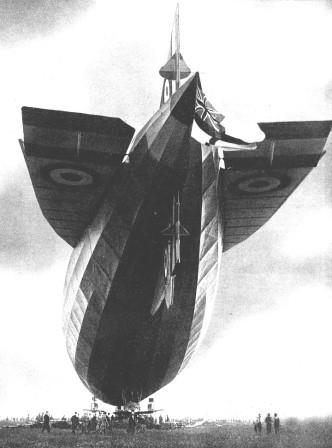
SHE DID BETTER THAN ANY AEROPLANE. Anchored safely on American soil, the R34 rides easily after her flight from Scotland. Three days after her arrival the dirigible rose again, returning home in record time. Her round trip, made in July 1919, occupied but 12 days inclusive (8 days’ flying time).
Passing through clouds and fog, the long, sleek form continued its journey throughout the day. At intervals the navigating officer would climb the high ladder within the girder structure to reach an aperture in the top of the ship from which he made his observations. Within the forward gondola the wireless operator sent and received radio messages. Day and night communication was maintained with England, the Azores, Newfoundland and surface craft. So, high above the ocean and far from land, the little community of air adventurers were constantly telling the world of their progress and taking in return weather reports, details of their position and messages of greeting and good wishes. At regular intervals the engines were stopped in turn to rest them and to allow of inspection. Calm efficiency prevailed, and the R34 through fog and rain moved on.
At 9 p.m. darkness descended once more and all aboard were pleased with the day’s work. Things were going well. With the coming of another day it was calculated that half their outward journey had been accomplished, and with plenty of power in hand the dirigible was maintaining an easy 55 miles per hour.
Up to then nothing had occurred to break the routine functioning aboard the craft. But as the day wore on a small defect in the mid starboard engine was reported in the form of a water leak in a cylinder jacket. Fortunately it was not of a serious nature; it was, in fact, so trivial that the application of some chewing-gum made a satisfactory remedy!
Some hours before this, a small sensation was caused by the sudden appearance of the first air stowaway in history. He turned out to bean aircraftsman who, disappointed at not being selected for duty on the voyage, had concealed himself in an obscure quarter of the airship. He became ill, however, and was forced to reveal himself.
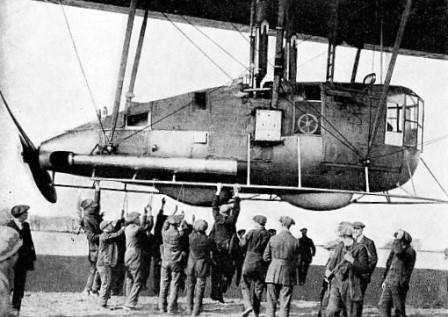
A POWER EGG. In this rear gondola (called a “power egg”) of the R34 were situated two 275 h.p. Sunbeam engines, the other three containing one engine each. The mechanics entered from the keel of the ship by a hatchway on the roof. The rails along the bottom of the gondola, to which the landing party clung, are seen, as also the landing bags protecting the base of the
gondola against damage.
In the early evening the R34 encountered tremendous rain clouds, but she climbed above these and went serenely on her way and, continuing, neared the fog-bound coast of Newfoundland. She had completed the ocean passage and the spirits of the men aboard were high as they crossed the coastline at Trinity Bay. But their journey was not yet over, and after 59 hours aloft they were still faced with a further 900 odd miles before their destination could be reached.
It was on this final stage of the trip that circumstances arose to provoke concern in Major Scott. The dirigible had passed far over Nova Scotia when bad storms blew up. Tremendous electrical discharges occurred close by, and the airship was pitched and buffeted alarmingly; so rough was the going, indeed, that at times the crew were compelled to cling to girders and stays to retain their foothold. Those in the control car were busy at their wheels holding their great craft to her course, and the thought must have been in the minds of all aboard — will she ride the storm? Certainly it must have come to the commander when, on looking aft, he saw the stern bend as one gigantic rush of wind assailed his ship. Disaster could not have been far away in those few tense moments.
Meanwhile another problem had arisen. The fuel supply was getting low, and Scott estimated that even with one or more of his engines shut off the chance of reaching their destination, Mineola, New York, was obscure, unless very favourable winds were met with. With keen disappointment, therefore, he wirelessed that he would make a premature landing at Chatham, Mass., and preparations were made accordingly. But as R34 pushed on, further calculations showed that there was a possibility of reaching their terminus after all. With engines throttled down they flew on, creeping nearer and nearer to the great landing ground at Mineola, where thousands waited in the morning sunshine to give a tumultuous welcome.
Suddenly a tiny figure fell away from the airship. It hurtled down, and then above it appeared the billowing white fabric of a parachute. It was Major James E. M. Pritchard, who had made his descent to supervise the landing. With the light glinting on her long, massive form, the airship dipped her nose and slid slowly, gently, earthward. A landing party grasped her handling rails and amidst a cheering multitude the crew disembarked, after four days of flying.
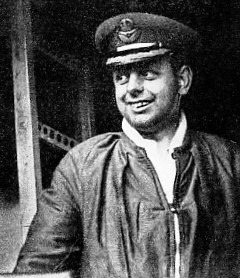
SMILE OF TRIUMPH. Major George Herbert Scott achieved his great ambition as captain of the R34 on her both ways Atlantic crossing. Here he is seen at the window of the main cabin, at the voyage’s end. He was killed tragically in the R101 disaster in 1930.
For three days Scott and his officers and his men were feted and besieged by enthusiastic and admiring Americans. Then, after a rapid but thorough overhaul and replenishment of fuel, ballast, oil and gas, the R34 rose into the air again to start her return journey. It was on the night of Wednesday, July 9, that the dirigible set off and, held in the bright beams of searchlights, she flew over New York. The airship had left Mineola at midnight, and at 2.17 a.m. she crossed the Newfoundland coast making for the Atlantic at 83 m.p.h.
It was Scott’s intention to make direct for London via Queenstown and the Bristol Channel. With smooth air and good visibility during the first day out the progress made was excellent and uneventful. Nothing disturbed the tranquillity of the ship until a crash in the aft engine car occurred. One of the engines had broken a connecting rod and wrecked the power unit beyond repair. Fortunately, in the fair weather that prevailed, the airship was able to keep a good speed on four engines.
As the miles went by, messages poured in from many radio stations, and the Air Ministry in distant London was constantly in touch, receiving reports of progress and sending weather information. In one message came news of an anticyclone off south-west Ireland, and Major Scott changed his course and the R34 was headed for East Fortune.
Soon after, the weather broke up; fog arose, obliterating sea and horizon, and the airship flew for hours in vaporous gloom. Throughout Friday she contended with bad weather — with fog,
then wind and heavy rain. But with the coming of dawn a welcome change occurred. The storm clouds had passed, the wind had dropped, and as they flew at 2,500 feet above the tranquil ocean the crew saw the glory of a mighty sunrise which presaged a gorgeous day. The ship was now running on three engines only, the fourth having been put out of action temporarily while valve springs were changed.
The knowledge that land could not now be far off caused some excitement amongst the crew, and eyes were constantly scanning the horizon for the first glimpse of the coast of Ireland. And at 7.25 p.m., 10 miles on the starboard bow, it was seen. A little under half an hour and the R34 sailed majestically over Clifden, where, but a few weeks before, Alcock and Brown had landed after their famous non-stop crossing. The airship traversed Ireland in the clear light shed by a bright full moon, heading towards Belfast en route for East Fortune. But once again a change came in the plans for their place of arrival. The Air Ministry wirelessed instructions for a landing at Pulham, Norfolk — so the course was reset.
In the early hours of Sunday morning the R34 reached her homeland, passing over the Mersey on a direct route to Pulham, which was reached at 6.20 a.m. The return trip had occupied just 3 days 3 hours. An historic feat, indeed, for it is a surprising fact that, apart from the crossing in 1928 of the “Graf Zeppelin” and the England-Canada and return flight of the R100 in the longer period July 29-Aug. 16, 1930, no aeroplane, and no other airship, has performed the double flight.
NEW YORK WELCOMES A STRANGE SHIP. After four days and twelve hours aloft, anti a stern battle with violent storms, the R34 came safely to earth at Mineola aerodrome, New York, on a bright July morning in 1919. For the first time the Atlantic had been crossed by air from east to west, and the Americans, fully appreciative of the feat, gave the British crew a mighty welcome. Here is the scene shortly after the airship’s landing.